Showing posts with label Sundials. Show all posts

January 29, 2023

Ornate Equatorial Sundial Paper Model

Equatorial Sundial Bastelbogen
This fully functional ornate sundial paper model was created by Secanda. Specifically, this is an "equatorial sundial" which the designer explains as:

"...its dial is parallel to the plane of the equator and its axis is parallel to the axis of rotation of the earth. It is therefore a kind of flat model of the terrestrial globe."

Secanda goes on to explain that a equatorial sundial is universal as it will work anywhere on the planet with no other modification than adjustments to the orientation and inclination of the disc. The printable PDF template for the model along with instructions in English and French may be downloaded here.

Other Astronomy Related Paper Models:

Polyhedron Skyglobe
Planets of the Solar System
Mars Topographic Globe
Printable Sundial Collection

January 22, 2022

Printable Sundial Collection

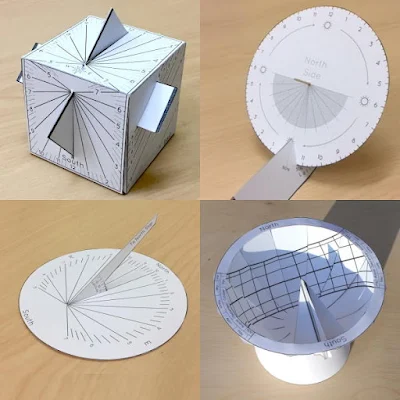
 I have always been fascinated by how many different types of sundials there are. The educational website, Astronomy for Thinkers, offers printable templates of five different types of sundials that have been used over the ages. Pictured above are a cube sundial, an equatorial sundial, a hemispherical sundial, and a horizontal sundial. Also available, but not pictured, is a butterfly sundial. Each sundial may be customized for your particular latitude on the planet. The earliest sundials were thought to have been created around 1500 BC.

Previous Astronomy Papercraft:

Polyhedron Skyglobe
Glue-less Earth Puzzle
Planets of the Solar System
Renaissance Crucifix Sundial
Mars Topographic Globe

October 13, 2010

Renaissance Crucifix Sundial Card Model


In the archives of the Germanic Museum in Nuremberg there is a Renaissance wood engraving that is thought to be the earliest paper model template ever created. The engraving was produced around 1529 by Georg Hartmann (1489 - 1564), a mathematician and designer of scientific instruments. When the template in the engraving is assembled it becomes a crucifix that also ingeniously functions as a sundial (the shadow in the photo on the right is at 11 o'clock).

There are numerous images on the crucifix. On the front is an engraving of the crucifixion of Christ that is very similar to a 1489 woodcut print by artist Albert Durer (1471 - 1528). Some sources suggest that Hartmann was a pupil of Durer's, which might explain the similarity. On the back of the crucifix is a bronze serpent on a cross and an image of Moses in reference to a miracle performed by Moses in Numbers 21:8-9. In the Gospel of John, Jesus Christ refers to Moses' miracle as a symbolic foreshadowing of his own crucifixion (John 3:14-15) thus explaining Hartmann's inclusion of the bronze serpent on the crucifix.

As far as I know there are no free papercraft templates of the crucifix, but reproductions may be purchased from several different European sources. One such source is here. Also on the same web page is a photo of the cross unfolded if you are curious.